















Course Overview
This course provides a comprehensive and structured exploration of Computed Tomography (CT) through 12 well-organized lectures, covering the fundamental principles, technical parameters, and advanced imaging techniques essential for clinical practice.
The course integrates theoretical foundations with practical insights, enabling learners to understand not only how CT images are formed, but also how to optimize image quality through appropriate parameter selection and scanning techniques. Special emphasis is placed on bridging the gap between physics, technology, and clinical application, with a strong focus on radiation dose optimization to ensure patient safety without compromising diagnostic image quality.
By the end of this course, learners will develop a solid conceptual framework that supports accurate image interpretation, efficient scanner operation, and informed decision-making in clinical practice, including the ability to balance image quality with optimal radiation dose in accordance with best clinical practices.
What you’ll learn
- Foundations & Core Principles
- CT Hardware & Scanning Techniques
- CT Parameters & Image Optimization
- Image Reconstruction & Visualization
- Quality Assurance & Dose Optimization
- Clinical Application & Interpretation
- Foundations & Core Principles: Gain a solid understanding of Computed Tomography (CT), from the physics of X-ray production to the mechanisms of CT image formation, including Linear Attenuation Coefficient and Hounsfield Unit (HU).
- CT Hardware & Scanning Techniques: Learn about the main components of CT systems, the types of scans (Axial, Helical, Scanogram), and acquisition protocols, enabling you to choose the most appropriate technique for different clinical scenarios.
- CT Parameters & Image Optimization: Master key parameters such as Slice Thickness, Rotation Time, Field of View (FOV), and Pitch, with practical strategies to optimize image quality while minimizing noise and radiation dose.
- Image Reconstruction & Visualization: Understand how raw HU data is converted into high-quality images, and apply advanced visualization techniques including windowing (WW/WL), Multiplanar Reconstruction (MPR), Curved MPR, MIP/MinIP, 3D Volume Rendering, and Virtual Endoscopy.
- Quality Assurance & Dose Optimization: Learn best practices to produce reliable, high-quality diagnostic images, with a focus on optimizing radiation dose to ensure patient safety without compromising image quality.
- Clinical Application & Interpretation: Develop the ability to combine theoretical knowledge with practical skills and apply all learned CT concepts and techniques directly to real-life clinical cases, supporting accurate diagnosis and effective decision-making in daily practice.
Target Audience
This course is designed for Radiology students, recent graduates, and clinical radiology professionals who wish to enhance their understanding of Computed Tomography (CT), strengthen their diagnostic and image interpretation skills, and confidently apply advanced imaging concepts in daily clinical practice.
- 12 Sections
- 13 Lessons
- 365 Days
- Lecture 1: Discovery of X-Rays & Fundamental PrinciplesOur journey begins with the discovery of X-rays by Wilhelm Röntgen and the revolutionary impact it had on medical imaging. We explore the basic physics of X-ray production and the factors (kVp, mAs) that control image quality, laying a strong foundation for understanding the fundamental principles of radiology.2
- Lecture 2: From X-Ray to CT1
- Lecture 3: CT Image Formation & Key Concepts2
- Lecture 4: CT Windowing & Clinical Applicationswe continue our journey into achieving optimal image formation, starting with the challenge that the human eye and display screens cannot distinguish all 2000+ Hounsfield Unit (HU) differences in a CT scan. This challenge is addressed through CT windowing (WW/WL), which allows us to select the tissue of interest—such as brain, bone, soft tissue, or lung—and map its HU values into visible grayscale. Finally, we demonstrate how these techniques are applied to real-life clinical cases encountered in daily practice.2
- Lecture 5: CT Generations & Dual Source CTContinuing our journey, we trace the evolution of CT scanners from the first to the seventh generation, highlighting the improvements in speed, image quality, and clinical capabilities at each stage. We explore why each new generation was developed and how it differs from the previous one, while introducing key concepts and innovations, such as helical vs. axial scanning and multidetector vs. multislice technology, that have significantly enhanced scanning efficiency and diagnostic performance.2
- Lecture 6: Data Acquisition & CT Hardware3
- Lecture 7: CT Scan Types ContinuedBuilding on our introduction to scan types, we explore the practical applications of the scanogram, including estimating patient radiation dose, positioning, and its effect on image quality. We then dive into axial scans, understanding their principle, use cases, and the types of examinations suited for this method. Finally, we cover helical scans, highlighting their principles, applications, and advantages in clinical practice.2
- Lecture 8: CT Parameters – Slice Thickness & Rotation TimeContinuing with CT scanning, we focus on key parameters like slice thickness and rotation time, understanding their effect on image clarity and scanning efficiency.2
- Lecture 9: CT Parameters – Field of View (FOV)Continuing our exploration of CT parameters, we focus on Field of View (FOV) and its influence on image resolution and coverage. We also introduce the important distinction between Scan FOV and Display FOV, and how each one affects image acquisition and visualization, linking these concepts to other scanning parameters for optimal imaging.2
- Lecture 10: CT Parameters – PitchNext, we complete our exploration of scanning parameters with CT pitch, learning how it affects image quality, scan time, and patient dose.2
- Lecture 11: Image Reconstruction & QualityContinuing our journey, we focus on image reconstruction, converting HU values into high-quality diagnostic images, and understanding how raw data is transformed into usable image data. We also explore the key concepts of image quality, including voxel vs. pixel, spatial resolution, and signal-to-noise ratio (SNR), and how these factors influence the final image.2
- Lecture 12: Image Reconstruction & DisplayFinally, we explore advanced reconstruction and display techniques, starting with Multiplanar Reconstruction (MPR), which includes reconstructed images on different planes, such as the Axial, Coronal, Sagittal, and Oblique planes. We then cover Curved MPR, Maximum Intensity Projection (MIP), Minimum Intensity Projection (MinIP), and 3D techniques such as Volume Rendering and Virtual Endoscopy. The lecture also discusses the role of filter functions (reconstruction kernels), how to select them appropriately, and how these techniques can be applied to real clinical cases in daily practice.2

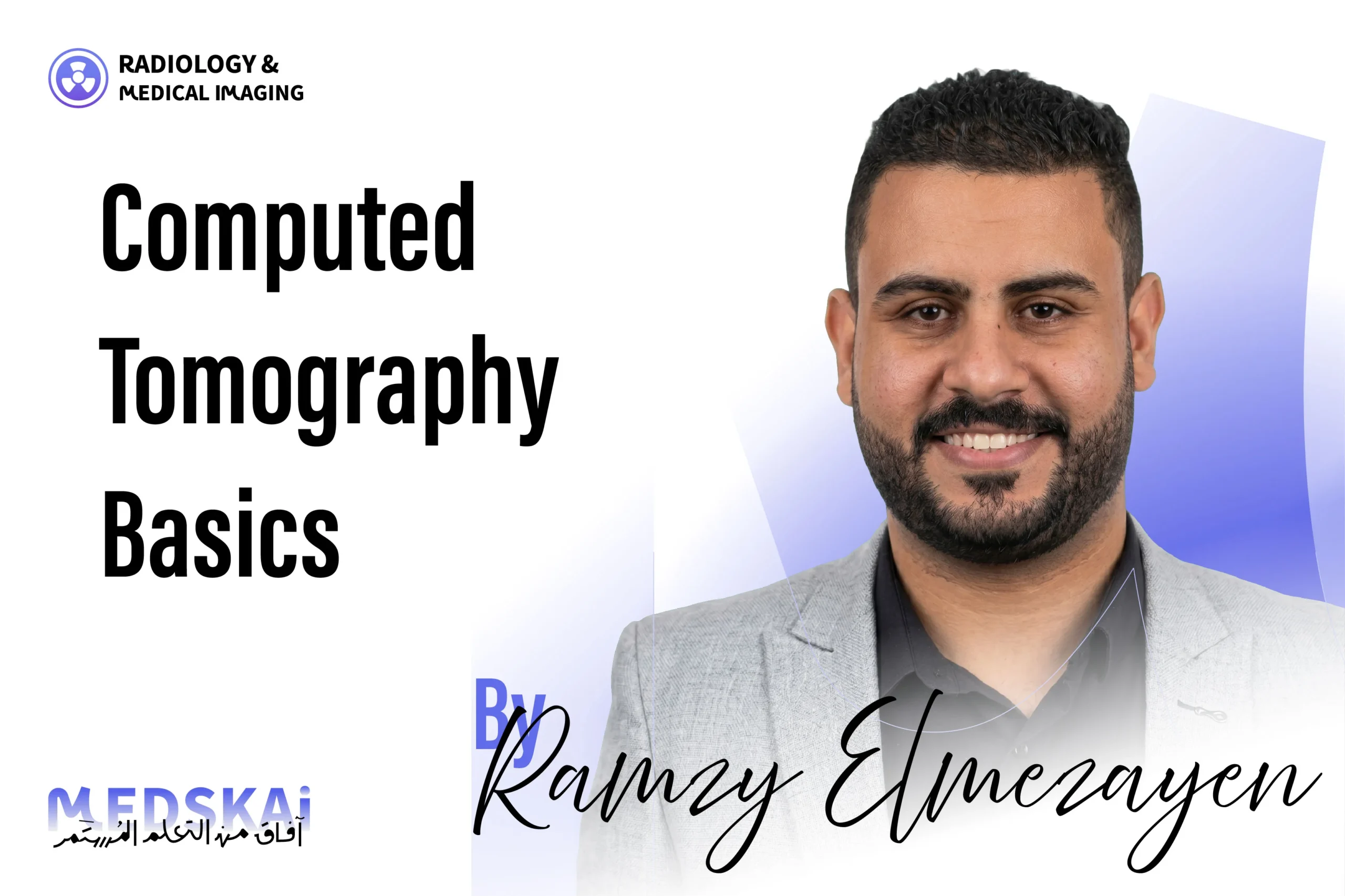
Radiological and Medical Imaging Specialist with a Master's degree in Medical Physics and extensive expertise in CT and MRI imaging. Founder of the Royal Radiology Academy platform and actively involved in medical education, online teaching, and curriculum development. Research interests focus on AI-based medical image analysis, particularly automated Gross Tumor Volume (GTV) delineation in brain tumor MRI. He is the author of multiple radiology textbooks, a published researcher in an international peer-reviewed radiology journal, and an invited speaker at the Egyptian International Radiology Conference (EIRC 2025).


Community Members Only
Join our community to unlock discussions, share knowledge and connect with members.
Join Discussions
Engage in meaningful conversations
Connect
Build relationships with members
Exclusive Access
Access member-only content