











AI in Radiology: Risks, Responsibility, and Responsible Integration
blogs
June 7, 2026
No Comments
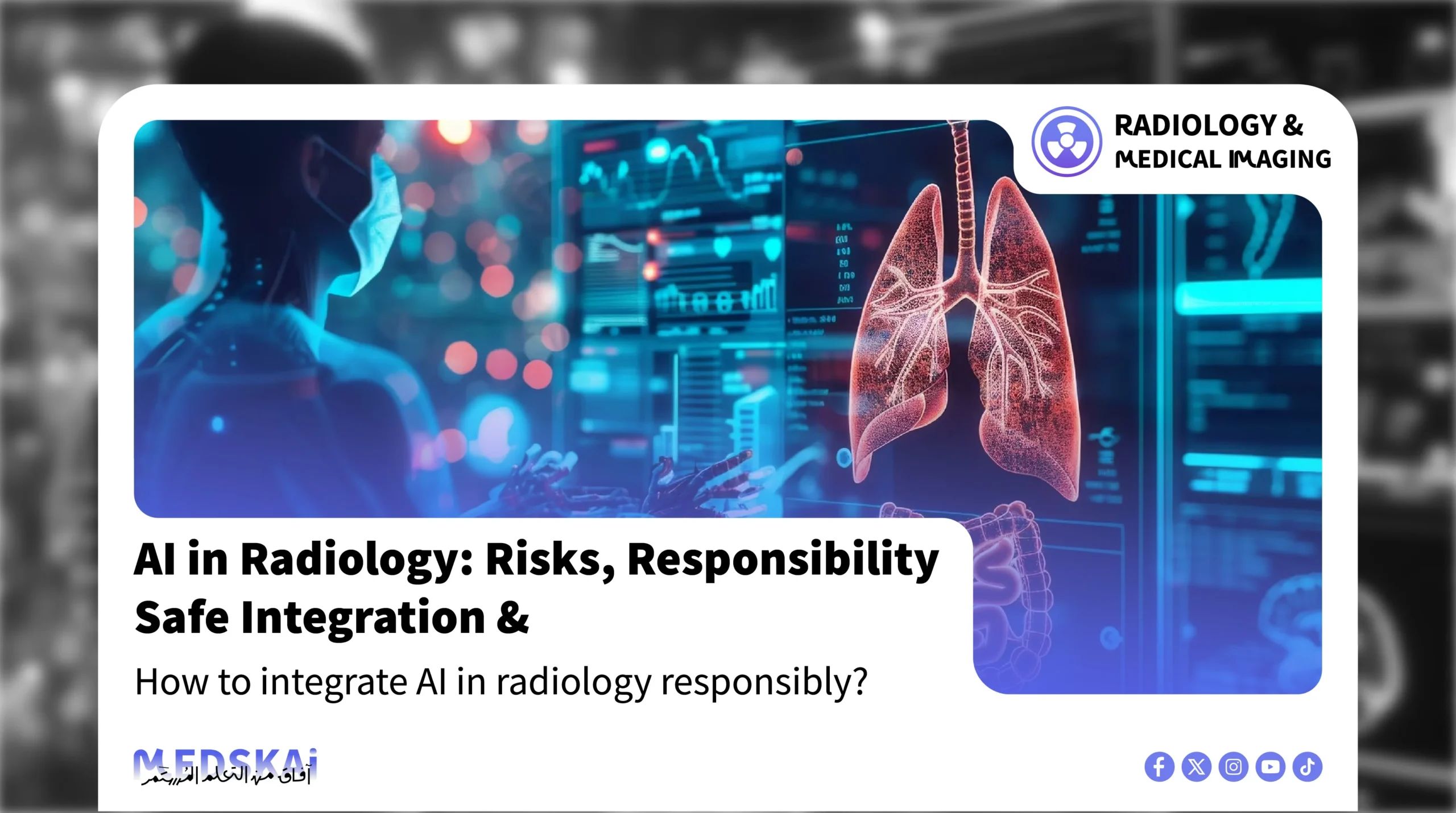
How to integrate AI in radiology responsibly: the three-layer risk model covering environmental safety, automation bias, and accountability.
Artificial intelligence is no longer a supporting feature in radiology. It is becoming part of the clinical infrastructure, assisting in detection, prioritizing findings, accelerating reporting, and increasingly shaping how decisions are made.
But integrating AI into radiology is not a simple technological upgrade. It is a structural transformation that reshapes three interconnected domains: the physical clinical environment, the clinician’s cognitive process, and the governance and accountability structure.
If we evaluate AI only through performance metrics, we miss the deeper shift. Responsible integration requires looking at the whole risk architecture, not just accuracy rates.
The Three-Layer Risk Architecture of AI in Radiology
Artificial intelligence does not introduce a single isolated risk. It modifies the system at multiple levels simultaneously. Understanding AI in radiology means understanding these three layers.
Layer One: Environmental Safety_ Technology Does Not Replace Discipline
Radiology is not purely digital; it is physical. It involves contrast injections, ultrasound probes, imaging tables, high patient turnover, and workflow under pressure. AI may enhance interpretation, but it does not interact with surfaces, gloves, or contamination pathways. Infection control remains entirely human.
When attention shifts heavily toward digital optimization, environmental vigilance can weaken. That imbalance is dangerous: a diagnostically perfect image does not compensate for compromised hygiene standards. The first layer of responsible AI integration is environmental discipline.
Layer Two: Cognitive Risk_ When Confidence Reduces Vigilance
As AI systems demonstrate high diagnostic performance, clinician trust increases. That trust is reinforced by data, but over time subtle changes occur: the algorithm flags, the clinician confirms.
This dynamic introduces automation bias in radiology — the tendency to over-trust automated outputs even when independent reassessment is warranted. Reduced scrutiny rarely feels negligent; it feels efficient. In high-volume environments, efficiency becomes habit, and habit reshapes perception.
There is also a long-term implication. Clinical pattern recognition develops through deliberate engagement with uncertainty. If early-career radiologists rely heavily on AI outputs from the start, skill acquisition may gradually weaken. AI should sharpen interpretation, not substitute it.
Layer Three: Governance and Accountability _ Who Carries Responsibility?
When artificial intelligence contributes to a diagnostic decision, accountability becomes complex. Under current legal frameworks, AI systems are classified as decision-support tools. They are not legal entities and cannot assume liability. The clinician who signs the report remains accountable.
But responsibility does not stop there. AI-enabled radiology involves a chain of actors:
- Developers who design and train the model
- Manufacturers responsible for validation and regulatory compliance
- Institutions that deploy and monitor performance
- Clinicians who interpret and confirm findings
In many jurisdictions, AI-based diagnostic systems are regulated as medical devices, imposing obligations for safety testing, documentation, and post-market surveillance. Deploying a system without local validation or real-world monitoring is not a technical oversight; it is a governance failure. Accountability cannot be delegated to code.
From Innovation to Integration: A Structured Framework
The challenge is not whether AI works. It is whether we integrate it responsibly. A sustainable model rests on three inseparable pillars:
- Environmental discipline: strict infection control, workflow integrity, and physical safety standards that remain uncompromised.
- Cognitive independence: clinicians retain independent verification, bias awareness, and active interpretative authority.
- Governance oversight: clear human-in-the-loop policies, local validation studies, explainability requirements, and transparent accountability structures.
These layers are interdependent. Strength in one does not compensate for weakness in another. Responsible AI integration is not about slowing innovation; it is about stabilizing it.
Why This Conversation Matters Now
AI adoption in radiology is accelerating, and decision-support tools are increasingly embedded in reporting systems. Regulatory frameworks are evolving but remain in transition, and the speed of deployment often exceeds the speed of governance adaptation.
If integration outpaces oversight, fragility increases. The future of radiology will be defined not solely by algorithmic performance, but by how well institutions balance innovation with structure, trust with verification, and efficiency with accountability. AI should extend clinical capability, not dilute responsibility.
Frequently Asked Questions
What are the main risks of AI in radiology?
AI introduces layered risks: environmental safety challenges, cognitive bias and over-reliance, and governance complexity related to accountability.
Can AI replace radiologists?
No. AI supports image analysis but does not replace contextual judgment, ethical responsibility, or final clinical authority.
Who is responsible for AI-related diagnostic errors?
Legal accountability remains human-centered, typically resting with clinicians and institutions, while manufacturers may bear responsibility in cases involving system defects.
How can hospitals implement AI safely?
Through structured validation, ongoing monitoring, human-in-the-loop protocols, bias-awareness training, and clear documentation standards.
Conclusion
Radiology does not need less humanity in the age of AI; it needs more deliberate structure. Innovation is valuable, but compromise on safety, judgment, and accountability is not.
Treat AI as an amplifier of clinical capability and pair every layer of automation with a matching layer of human oversight.
Categories
Archives
Tags
ABG
AI
Artificial intelligence
CT
Diagnosis
Egypt
Ethics
GCC 2026
Genomic
Medical
Modality-specific knowledge is essentialModality-specific knowledge is essential
Molecular
MRI
PACS
Patient safety and ALARA compliance are top priorities
PET
Radiology
Radiology interviews focus on clinical judgment
Radiotherapy
RIS
Scenario-based thinking is critical
Structured answers (STAR method) improve performance
US
X-ray
You May Also Like
Beyond the Assumption That AI Is Always Right Artificial intelligence has transformed modern radiology. It detects patterns faster than the...
-
April 19, 2026
In clinical practice, airway management is not just about choosing a device or technique. It is about making the right...
-
-
April 19, 2026
Medical ethics is not limited to physicians and nurses. In modern healthcare systems, paramedical and allied health professionals play a...
-
-
April 8, 2026

Company
Help Center
Help Center
Company
mobile app