












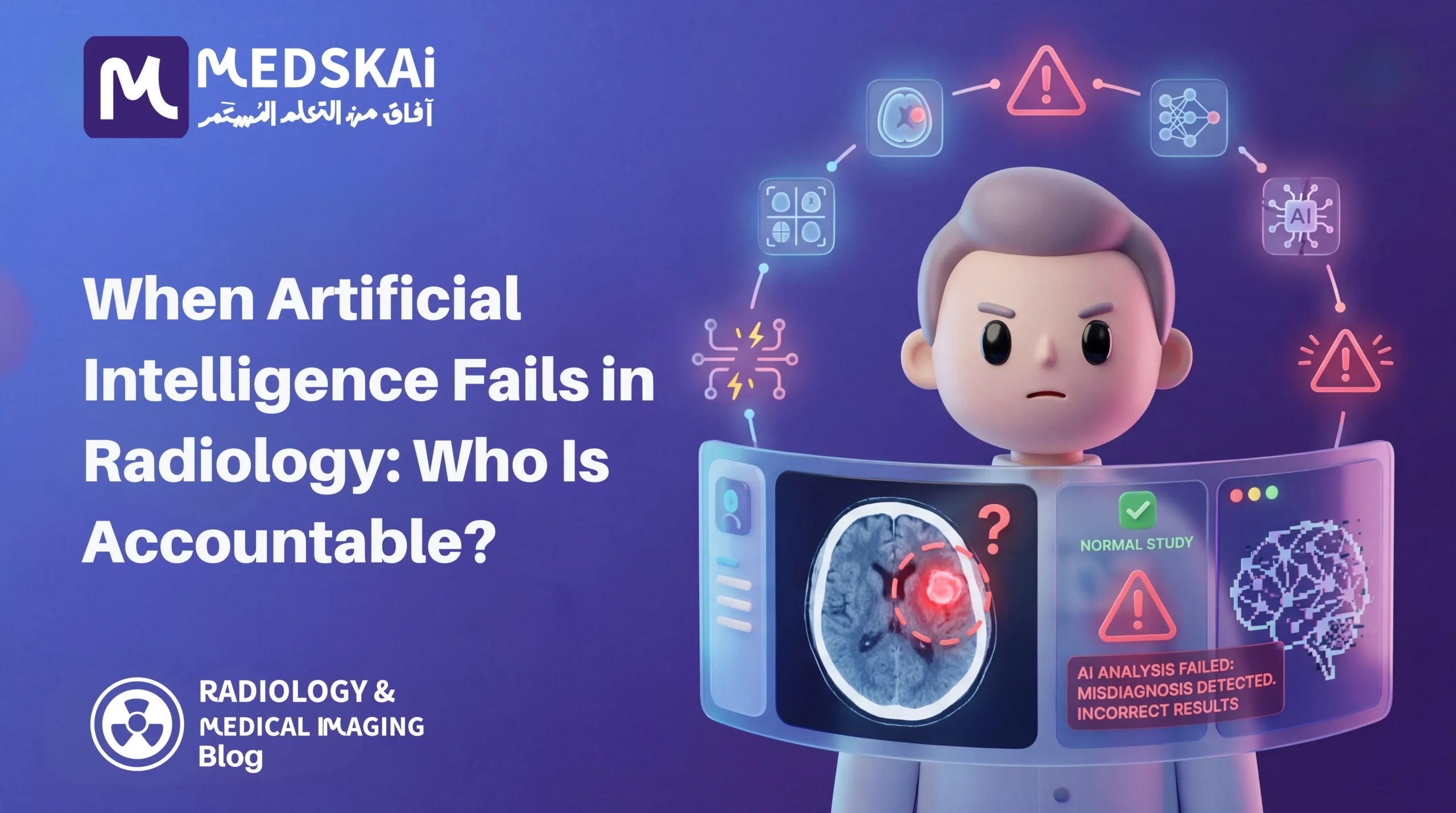
When Artificial Intelligence Fails in Radiology: Who Is Accountable?
drhout
April 8, 2026
No Comments
Beyond the Assumption That AI Is Always Right
Artificial intelligence has transformed modern radiology. It detects patterns faster than the human eye, flags subtle abnormalities, and supports clinical decision-making in ways that were unimaginable a decade ago. In many settings, it has improved efficiency and reduced oversight fatigue.
But a difficult question remains.
When artificial intelligence fails in radiology, when an algorithm misinterprets an image and that error contributes to delayed treatment or patient harm, who is responsible?
This is not a technical question.
It is a legal and ethical one.
AI accountability in radiology is becoming one of the most pressing issues in modern clinical governance. Because when harm occurs, responsibility cannot be assigned to a machine.
AI Is Not a Legal Person
Under current legal frameworks, artificial intelligence is not recognized as a legal entity. It cannot be sued. It cannot be prosecuted. It cannot assume liability.
In clinical practice, AI systems are classified as decision-support tools. The final authority rests with the physician who signs the report.
That signature matters.
Even if the algorithm performed most of the analytical work, the clinician remains legally accountable for the final interpretation. The law recognizes human agency, not computational output.
This creates a quiet imbalance.
If the system influences the decision, but the doctor holds the liability, the distribution of responsibility becomes complicated.
The Black Box Problem
Many advanced AI models operate with limited explainability. They may produce a confident output “malignant” or “normal” without clearly revealing the reasoning behind that conclusion.
This introduces a structural dilemma.
Should a clinician be fully responsible for endorsing a recommendation generated by a process they cannot independently audit?
Explainability is not a technical luxury. It is a safeguard.
If clinicians cannot interrogate the reasoning behind an AI recommendation, oversight becomes procedural rather than analytical. The physician signs the report but may not fully understand the computational pathway that shaped the result.
That gap matters.
Shared Responsibility: A Chain, not a Single Link
Accountability in AI-enabled radiology does not begin and end with the radiologist.
It exists across a chain:
- The developer who designs and trains the algorithm
- The manufacturer responsible for validation and regulatory approval
- The hospital that selects and deploys the system
- The clinician who interprets and signs the report
If an AI failure stems from flawed training data, coding defects, or inadequate validation, the issue moves beyond individual clinical judgment. It becomes a matter of product liability.
In many jurisdictions, AI-based diagnostic tools are regulated as medical devices. That classification carries obligations for safety testing, performance monitoring, and post-market surveillance.
It is not reasonable to expect a radiologist to detect hidden software flaws. Responsibility for algorithmic integrity must include those who build, certify, and distribute the technology.
At the same time, institutional responsibility cannot be ignored.
Institutional Duty and Clinical Governance
Hospitals are not passive adopters of technology. They are responsible for safe implementation.
Deploying an AI system trained on one population into a demographically different setting without local validation is not just a technical oversight it is a governance failure.
Clinical governance frameworks should include:
- Local validation of AI performance before full deployment
- Ongoing monitoring of diagnostic accuracy
- Clear human-in-the-loop protocols
- Transparent documentation of AI involvement in clinical decisions
AI integration is not a simple upgrade. It is a system-level transformation. And systems require oversight.
The Myth of Algorithmic Fairness
There is a persistent belief that algorithms are neutral.
AI reflects its training data. If that data lacks diversity or contains embedded biases, performance disparities will follow.
Variations in imaging equipment, acquisition protocols, and patient demographics can all influence model performance. An algorithm trained in a high-resource academic center may not perform identically in a rural or under-resourced clinic.
This is not intentional bias. It is statistical limitation.
But the consequences are clinical.
Fairness cannot be assumed. It must be tested.
The Cognitive Trap: When Vigilance Declines
There is another layer of accountability, one that is psychological.
As AI systems demonstrate strong performance, clinician confidence in those systems increases. Over time, independent scrutiny may subtly decline.
Automation bias does not remove responsibility. It reshapes how that responsibility is exercised.
If the final signature becomes routine confirmation rather than critical reassessment, accountability weakens, not legally, but cognitively.
The risk is not that AI replaces radiologists.
The risk is that it gradually reshapes vigilance.
Regulation Is Evolving but Not Fast Enough
Regulatory bodies such as the U.S. Food and Drug Administration (FDA) and European authorities increasingly classify AI-enabled diagnostic tools as regulated medical devices. The proposed European AI Act further emphasizes risk-based oversight and transparency.
Yet adaptive algorithms, continuous learning systems, and cross-border data usage introduce complexities that traditional regulatory frameworks were not designed to manage.
Law is evolving.
But governance at the institutional level cannot wait for legislation alone.
Healthcare organizations must proactively define boundaries, escalation pathways, and documentation standards when AI recommendations conflict with clinical judgment.
Accountability Cannot Be Automated
Ultimately, accountability remains human.
A system can calculate probability. It can highlight patterns. It can process data on a scale.
But it cannot assume moral responsibility.
When harm occurs, the question will not be:
“What did the algorithm compute?”
It will be:
“Who ensured this system was safe to use?”
Artificial intelligence should strengthen radiology, not blur the lines of responsibility.
Clinical authority must remain anchored in human judgment, even as technology expands our analytical capacity.
Innovation is valuable.
But accountability is non-negotiable.
Frequently Asked Questions
Who is legally responsible when AI makes a mistake in radiology?
Under current legal frameworks, AI systems are considered decision-support tools. The physician who signs the final report remains legally accountable. However, liability may extend to manufacturers or institutions if system defects or improper deployment contributed to the error.
Can artificial intelligence be sued for medical errors?
No. AI systems are not legal persons. Legal responsibility rests with humans and organizations involved in development, certification, deployment, and clinical use.
What is the “black box” problem in medical AI?
The black box problem refers to AI systems that generate outputs without transparent explanations. Limited explainability complicates oversight and raises ethical and legal concerns about responsibility.
Can hospitals be held responsible for AI-related harm?
Yes. Hospitals have a duty to validate AI tools, monitor performance, and ensure appropriate implementation. Failure to assess suitability for their patient population may constitute institutional negligence.
References
- U.S. Food and Drug Administration. (2023). Artificial intelligence and machine learning (AI/ML)-enabled medical devices.
https://www.fda.gov/medical-devices/software-medical-device-samd/artificial-intelligence-and-machine-learning-aiml-enabled-medical-devices- European Commission. (2021). Proposal for a Regulation laying down harmonised rules on artificial intelligence (Artificial Intelligence Act).
- European Parliament & Council. (2017). Regulation (EU) 2017/745 on medical devices.
- World Health Organization. (2021). Ethics and governance of artificial intelligence for health.
- Topol, E. (2019). Deep medicine: How artificial intelligence can make healthcare human again. Basic Books.
Categories
Archives
Tags
ABG
AI
Artificial intelligence
CT
Diagnosis
Egypt
Ethics
GCC 2026
Genomic
Medical
Modality-specific knowledge is essentialModality-specific knowledge is essential
Molecular
MRI
PACS
Patient safety and ALARA compliance are top priorities
PET
Radiology
Radiology interviews focus on clinical judgment
Radiotherapy
RIS
Scenario-based thinking is critical
Structured answers (STAR method) improve performance
US
X-ray
You May Also Like
Beyond the Assumption That AI Is Always Right Artificial intelligence has transformed modern radiology. It detects patterns faster than the...
-
April 19, 2026

In clinical practice, airway management is not just about choosing a device or technique. It is about making the right...
-
-
April 19, 2026
Medical ethics is not limited to physicians and nurses. In modern healthcare systems, paramedical and allied health professionals play a...
-
-
April 8, 2026

Company
Help Center
Help Center
Company
mobile app