











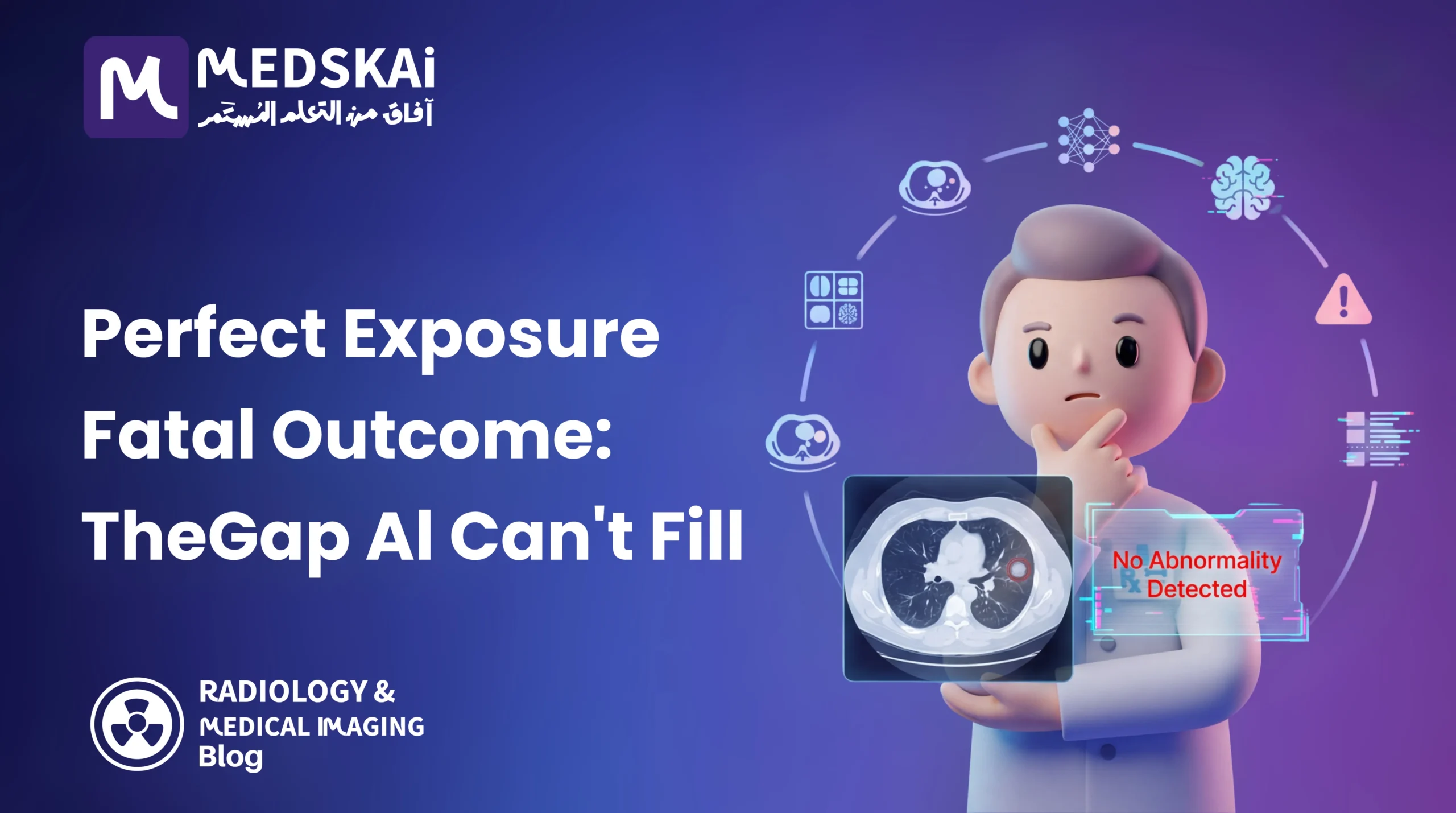
Perfect Exposure, Fatal Outcome: The Gap AI Can’t Fill
Infection Control in Radiology in the Age of Artificial Intelligence
Radiology training often emphasizes image quality, positioning, and technical precision. Yet one critical dimension is frequently underestimated: infection control. In an era increasingly shaped by artificial intelligence, this blind spot becomes even more dangerous.
Why is the Human Role so important in the age of AI?
AI excels at data interpretation and pattern recognition in medical imaging. However, it operates within digital parameters and does not engage with the physical clinical environment.
Artificial intelligence enhances diagnostic interpretation, but it has no physical agency. It cannot sterilize equipment, replace contaminated gloves, or enforce hygiene compliance. Infection control remains a fundamental human responsibility.
Studies in healthcare settings consistently identify inadequate hand hygiene and environmental contamination as major contributors to hospital-acquired infections. Imaging departments are not exempt from these risks.
Studies have documented contamination of imaging equipment, including ultrasound probes, radiography tables, and control panels, when disinfection protocols are inconsistently applied. In high-turnover departments, workflow pressure increases the risk of lapses in environmental hygiene.
If we focus on the digital image and forget about the physical environment, we are not doing our job. A diagnostically perfect image loses its value if infection control standards are compromised. Diagnostic excellence and environmental safety are inseparable components of quality care.
Can AI handle the reality of the clinic?
The doctor asked us a question in the lecture: “What would you do if a patient you were injecting with contrast suddenly vomited or bled on your clothes?” He explained that if you are not wearing your lab coat or eye protection you have likely contracted an infection. But he said something even more important: “Do not make the patient feel guilty. Tell them it is okay to be kind to them.”
This highlights a dimension of care that no algorithm can replicate. A machine cannot offer a word to a sick person who just had an accident. It cannot look into a patient’s eyes and says: “Do not worry, I am here to help.”
Patients in clinical settings are vulnerable, both physically and emotionally. If we use unsterilized hands, we turn the patient’s hope into a cause for their suffering. It is a tragedy to go to the hospital for one problem and leave with a fatal disease.
The Blue Shield Trap: Is every hand a safe hand?
We often feel safe when we see a healthcare provider wearing gloves. This often reflects misplaced trust. I call it the “Blue Shield Trap”. Think about it: “Touching a patient, then a mobile phone, then imaging controls with the same gloves creates a direct pathway for cross-contamination. The glove is not protecting anyone; it is basically a “shuttle” for germs. In this case the gloved hand is not a shield; it is the root of the infection.
This reflects a systemic issue in workflow discipline rather than individual negligence. Gloves do not replace proper hygiene protocols. Such lapses extend risk beyond the individual patient, potentially affecting broader clinical safety.
The Accountability Crisis: Who do we blame?
As we move toward relying on artificial intelligence and deep learning we face a serious question: If a patient becomes a victim of infection who is to blame? The machine or the human?
AI lacks moral agency. Accountability in healthcare cannot be delegated to algorithms. Responsibility for patient safety remains inherently human.
This responsibility falls squarely on our shoulders. Technological advancement cannot compensate for fundamental failures in hygiene compliance.
Bridging the Training Gap
If infection control is not embedded within AI-driven radiology workflows and training programs, the gap will widen. Future radiology education must integrate artificial intelligence competencies with strict environmental safety standards.
Radiology curricula must evolve to ensure that AI literacy and infection control training develop in parallel. Technical sophistication without safety discipline creates systemic vulnerability.
Conclusion
Technology may enhance diagnostic precision, but patient safety depends on human vigilance. As artificial intelligence becomes embedded in medical imaging, we must ensure that ethical responsibility and infection control remain central to clinical practice. Innovation without discipline is a hidden risk. In the AI-driven radiology suite, human accountability remains the final safeguard.
As artificial intelligence reshapes diagnostic accuracy, it must not dilute responsibility. The future of radiology will not be defined by algorithms alone, but by the standards we refuse to compromise.
Continuing the Responsibility
If artificial intelligence is transforming radiology, then our training must evolve with it. Clinical excellence requires more than technical skill; it demands awareness, discipline, and ethical responsibility.
For those who want to deepen their understanding of AI in medical imaging and strengthen their clinical foundations, structured learning makes the difference. Explore advanced courses and professional development programs at MedSkai: https://medskai.com/
References
World Health Organization. (2016). Guidelines on core components of infection prevention and control programmes at the national and acute health care facility level. World Health Organization.
Centers for Disease Control and Prevention. (n.d.). Healthcare-associated infections (HAIs). https://www.cdc.gov/hai/
Schaefer, G., et al. (2015). Contamination of ultrasound probes: Infection prevention recommendations. American Journal of Infection Control, 43(7), e45–e50. https://doi.org/10.1016/j.ajic.2015.03.024
Ofstead, C. L., Wetzler, H. P., Snyder, A. K., & Horton, R. A. (2010). Potential for healthcare-associated infections from contaminated surfaces in radiology. Journal of the American College of Radiology, 7(8), 599–606. https://doi.org/10.1016/j.jacr.2010.03.002
Topol, E. (2019). Deep medicine: How artificial intelligence can make healthcare human again. Basic Books.
Categories
Archives
Tags
ABG
AI
Artificial intelligence
CT
Diagnosis
Egypt
Ethics
GCC 2026
Genomic
Medical
Modality-specific knowledge is essentialModality-specific knowledge is essential
Molecular
MRI
PACS
Patient safety and ALARA compliance are top priorities
PET
Radiology
Radiology interviews focus on clinical judgment
Radiotherapy
RIS
Scenario-based thinking is critical
Structured answers (STAR method) improve performance
US
X-ray
You May Also Like
Medical ethics is not limited to physicians and nurses. In modern healthcare systems, paramedical and allied health professionals play a...
-
-
April 8, 2026
Beyond the Assumption That AI Is Always Right Artificial intelligence has transformed modern radiology. It detects patterns faster than the...
-
-
April 8, 2026
By 2026, Egypt and GCC imaging sectors have pivoted toward high-value, informatics-driven care. Per the Lancet Oncology Commission (Hricak et...
-
-
April 8, 2026

Company
Help Center
- Terms of Service
Help Center
- Terms of Service
Company
Help Center
- Terms of Service
- Privacy Policy
- Accessibility
- Refund Policy
- Report Issue
mobile app


download now
@ 2025 MedSkAi All rights reserved — Powered by csdiff