












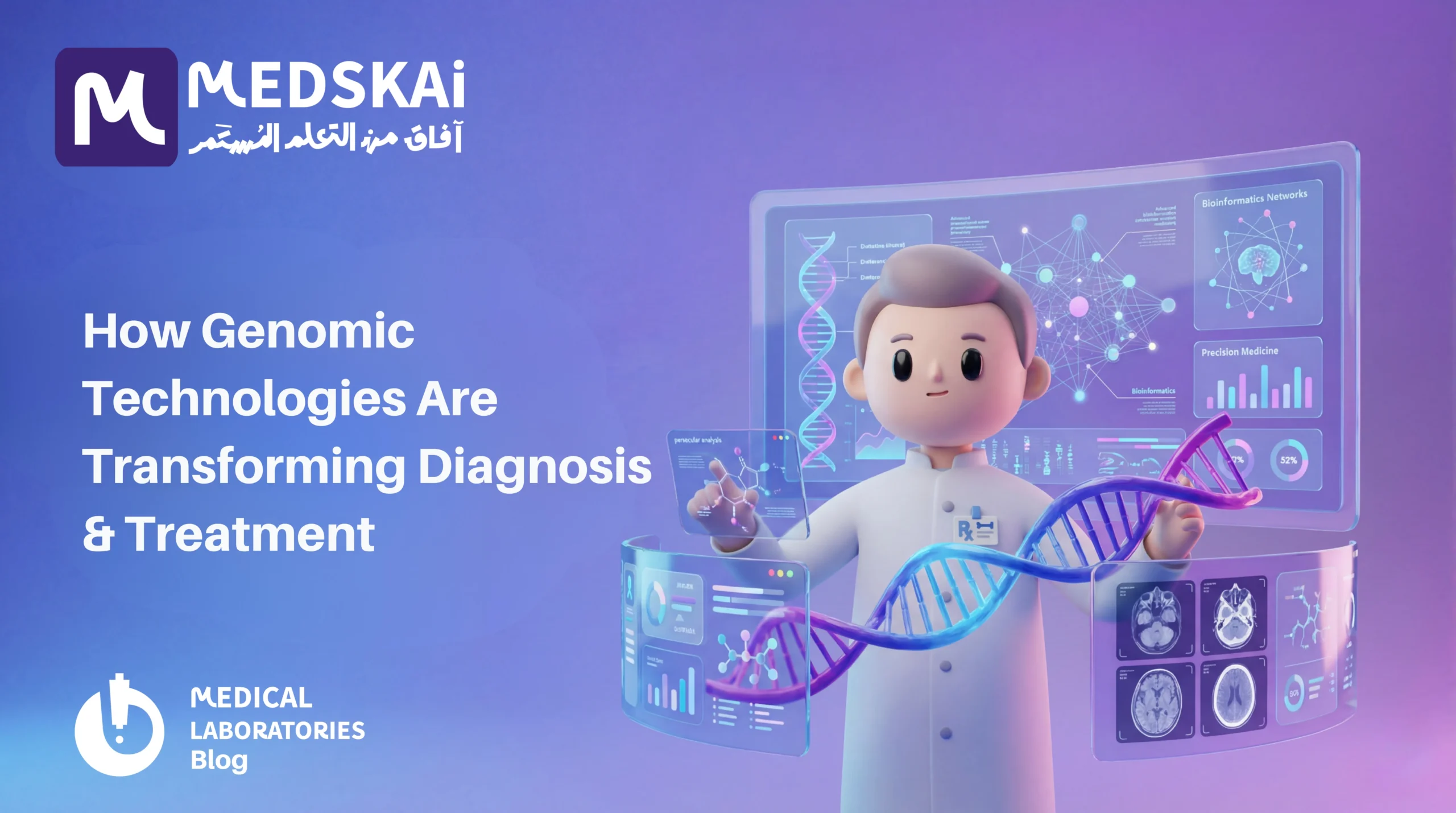
How Genomic Technologies Are Transforming Diagnosis and Treatment
Genomics has moved from being a research-focused discipline to a core component of modern clinical practice. Over the past decade, rapid advances in sequencing technologies have significantly reduced cost and turnaround time, making genomic testing more accessible across healthcare systems.
Today, clinicians can identify disease-associated genetic variants with high precision, enabling earlier diagnosis, risk stratification, and personalized treatment decisions.
For students and graduates of Applied Medical Sciences, understanding genomics is no longer optional. It is becoming foundational to laboratory diagnostics, oncology, pharmacology, prenatal screening, and infectious disease management.
What Is Genomic Medicine?
Genomic medicine involves the use of an individual’s genomic information as part of their clinical care. This approach allows healthcare providers to diagnose diseases, predict outcomes, and guide treatment decisions based on the unique genetic makeup of each patient. It is often associated with terms like personalized medicine and precision medicine, which emphasize tailoring medical care to the individual characteristics of each patient.
It includes:
- Whole Genome Sequencing (WGS)
- Whole Exome Sequencing (WES)
- Targeted gene panels
- Pharmacogenomic testing
- Chromosomal microarray analysis
Unlike traditional molecular diagnostics that focus on specific genes or mutations, genomic medicine allows comprehensive analysis of the entire coding or non-coding genome.
Genomic Technologies in Clinical Practice
Genomic applications are now integrated across multiple medical specialties:
- Oncology
Cancer genomics enables identification of driver mutations that guide targeted therapy selection.
Examples include EGFR, KRAS, and BRCA mutations that influence treatment strategies according to international guidelines such as ESMO.
- Infectious Diseases
Next-generation sequencing supports:
- Rapid pathogen identification
- Antimicrobial resistance detection
- Outbreak tracking
This has become particularly relevant in emerging infectious disease surveillance.
- Genetic Counseling
Genomic testing helps assess inherited disease risk, supporting preventive strategies and family planning decisions.
- Prenatal and Neonatal Diagnostics
Early detection of chromosomal abnormalities improves clinical planning and neonatal outcomes.
Clinical Case Examples
Case 1: BRCA1 Mutation Detection
A 32-year-old woman with a strong family history of breast cancer undergoes genetic testing. Detection of a pathogenic BRCA1 variant enables:
- Enhanced surveillance
- Preventive strategies
- Informed family risk assessment
Evidence shows that appropriate preventive interventions significantly reduce cancer incidence in high-risk individuals.
Case 2: Pharmacogenomics and Drug Response
A patient prescribed clopidogrel is found to carry a CYP2C19 loss-of-function variant.
Switching therapy reduces the risk of treatment failure, illustrating how pharmacogenomics directly improves therapeutic outcomes.
Case 3: Rare Pediatric Diagnosis
A child with unexplained developmental delay undergoes exome sequencing.
Identification of a de novo pathogenic mutation provides:
- A definitive diagnosis
- Prognostic clarity
- Appropriate genetic counseling
For rare diseases, genomic testing often shortens the diagnostic journey.
Why Is Data Interpretation the Main Challenge in Genomic Medicine?
Although sequencing technology generates massive amounts of data rapidly, interpretation remains the most critical bottleneck.
1. Variants of Uncertain Significance (VUS)
Many detected variants cannot be confidently classified as pathogenic or benign.
According to ACMG guidelines, standardized frameworks are required to interpret sequence variants reliably.
2. Volume and Complexity of Data
Each genome contains millions of variants. Most are benign polymorphisms.
Distinguishing clinically actionable mutations requires advanced filtering strategies and curated databases.
3. Bioinformatics Infrastructure
Accurate analysis depends on:
- Computational pipelines
- Variant annotation tools
- Machine Learning Models
- Multidisciplinary collaboration between clinicians and bioinformaticians
Without proper interpretation, genomic data cannot translate into clinical value.
Traditional Molecular Diagnostics vs. Advanced Genomic Sequencing
| Feature | Traditional Molecular Diagnostics | Advanced Genomic Sequencing |
| Examples | PCR, qPCR, FISH, Microarrays | Whole Genome Sequencing, Exome Sequencing |
| Cost | Lower | Higher cost but decreasing rapidly |
| Scope | Limited variant detection | Comprehensive variant identification |
| Use Case | Known mutation testing | Complex or unknown conditions |
| Clinical Impact | Focused diagnosis | Personalized medicine |
Ethical and Legal Considerations
- Privacy and confidentiality of genomic data.
- Informed consent for genetic testing.
- Secondary findings management
- Data sharing regulations and compliance with GDPR/HIPAA.
Clinical Impact and Statistics of Genomic Medicine
- BRCA1/BRCA2 testing reduces breast cancer risk by up to 50% with preventive measures.
- Pharmacogenomic-guided therapy improves drug efficacy by 30-40%.
- Early detection of chromosomal abnormalities reduces neonatal complications by 25%.
The Future of Genomics in Healthcare
The future directions include:
- Integration of AI in genomic interpretation
- Real-time clinical decision support systems
- Population-scale genomic screening
- Expansion of precision oncology
- Broader accessibility in low- and middle-income countries
For healthcare professionals, genomic literacy will become a defining competency over the next decade.
Frequently Asked Questions
- What does Genomic Testing Mean?
- Genomic testing is a laboratory analysis that examines a person’s DNA to identify genetic variations linked to disease risk, diagnosis, or treatment response. It may analyze a single gene, a gene panel, the exome, or the entire genome depending on the clinical need. Genomic testing supports personalized medicine by helping clinicians select targeted therapies and preventive strategies.
- When Is Genomic Testing Recommended?
- Genomic testing is typically recommended in cases such as:
- Suspected inherited disorders
- Early-onset or familial cancers
- Unexplained developmental delays
- Recurrent pregnancy loss
- Drug response optimization (pharmacogenomics)
The decision is based on clinical evaluation and specialist consultation.
- Why is data interpretation considered the main challenge in genomic medicine? Although genomic technologies enable rapid data generation, the main challenge lies in interpreting the vast amount of genomic data. Many detected variants are classified as variants of unknown significance (VUS), which complicates clinical decision-making. Additionally, the large volume of benign genetic variations requires advanced bioinformatics pipelines to identify pathogenic variants accurately. Therefore, effective data interpretation is essential for translating genomic information into clinical applications.
Ready to Advance Your Skills in Genomic
If you want structured, practical learning designed specifically for Applied Medical Sciences students and graduates, explore the specialized courses available on MedSkai
- Build your knowledge in:
- Molecular diagnostics
- Clinical genomics
- Laboratory technologies
- Precision medicine applications
- Start strengthening your professional profile with courses built for real clinical impact.
👉 Visit the MedSkai platform and begin your learning journey today.
References
- American College of Medical Genetics and Genomics (ACMG). Standards and guidelines for interpretation of sequence variants. 2021.
- European Society for Medical Oncology (ESMO). Clinical practice guidelines for cancer genomics. 2022.
- Nature Genetics. Advances in genomic medicine and personalized care. 2023.
Categories
Archives
Tags
ABG
AI
Artificial intelligence
CT
Diagnosis
Egypt
Ethics
GCC 2026
Genomic
Medical
Modality-specific knowledge is essentialModality-specific knowledge is essential
Molecular
MRI
PACS
Patient safety and ALARA compliance are top priorities
PET
Radiology
Radiology interviews focus on clinical judgment
Radiotherapy
RIS
Scenario-based thinking is critical
Structured answers (STAR method) improve performance
US
X-ray
You May Also Like
Medical ethics is not limited to physicians and nurses. In modern healthcare systems, paramedical and allied health professionals play a...
-
-
April 8, 2026
A Practical Framework for Safety, Judgment, and Accountability Artificial intelligence is no longer a supporting feature in radiology. It is...
-
-
March 27, 2026
Infection Control in Radiology in the Age of Artificial Intelligence Radiology training often emphasizes image quality, positioning, and technical precision....
-
-
March 27, 2026

Company
Help Center
- Terms of Service
Help Center
- Terms of Service
Company
Help Center
- Terms of Service
- Privacy Policy
- Accessibility
- Refund Policy
- Report Issue
mobile app


download now
@ 2025 MedSkAi All rights reserved — Powered by csdiff